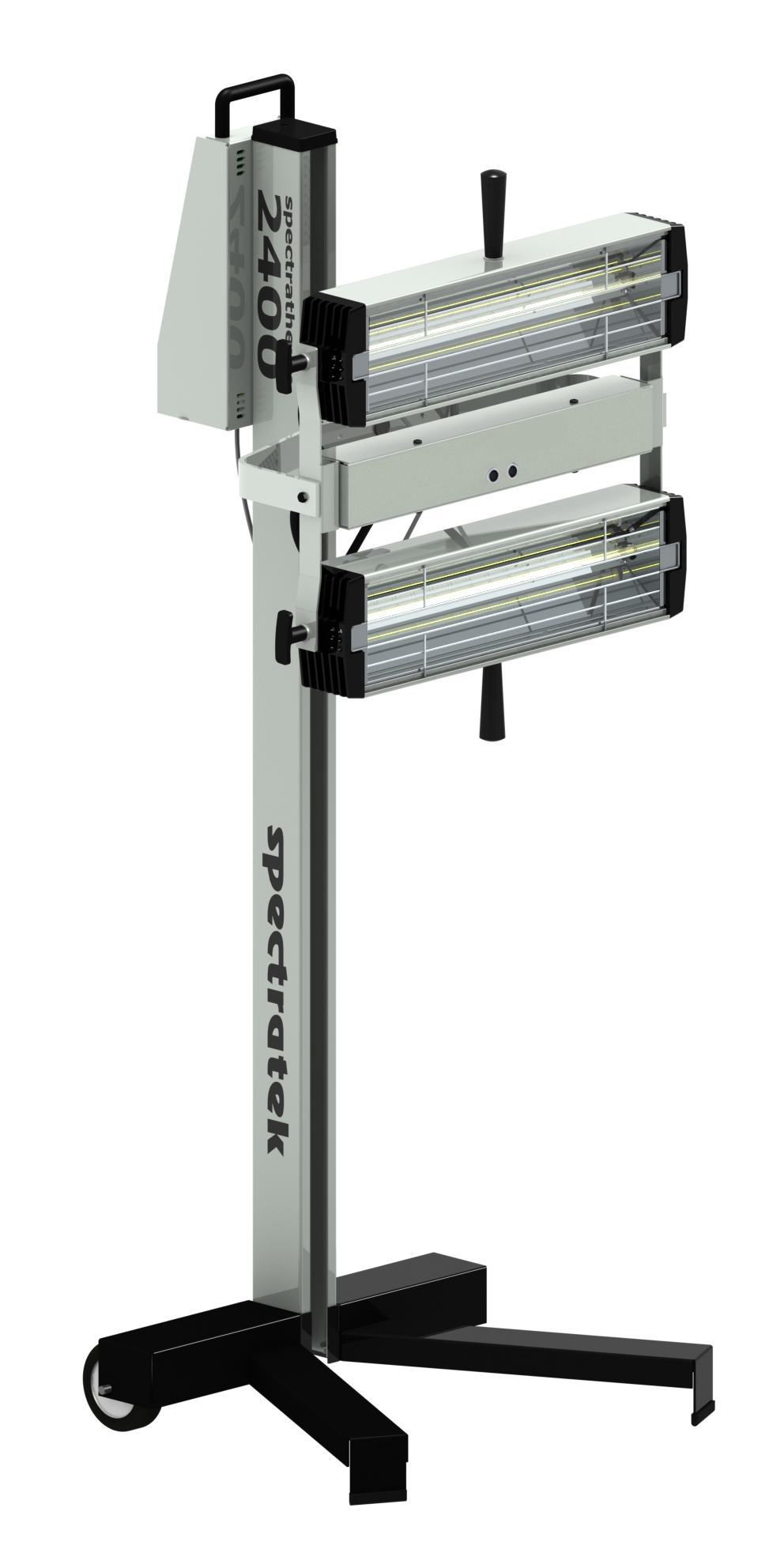
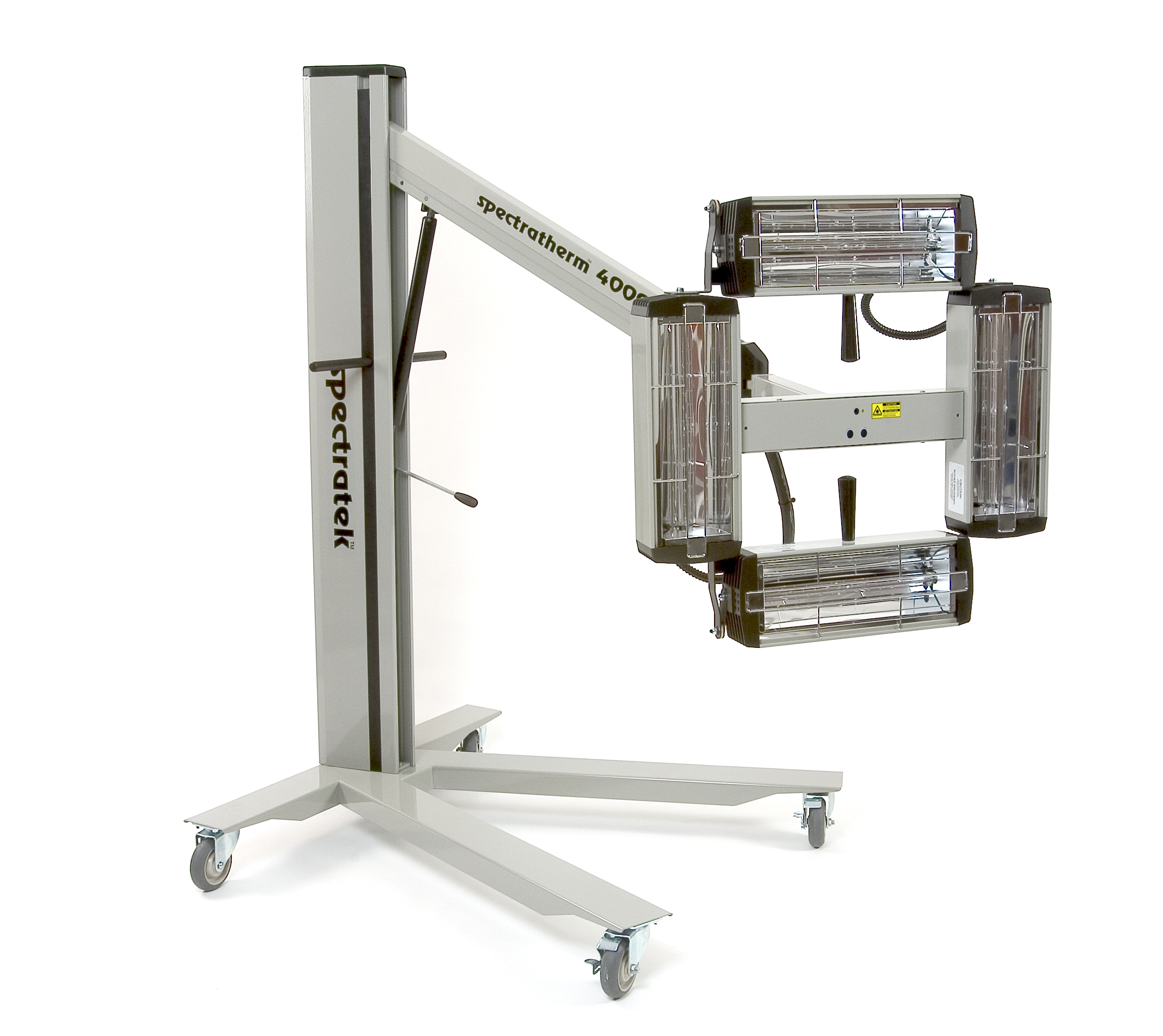
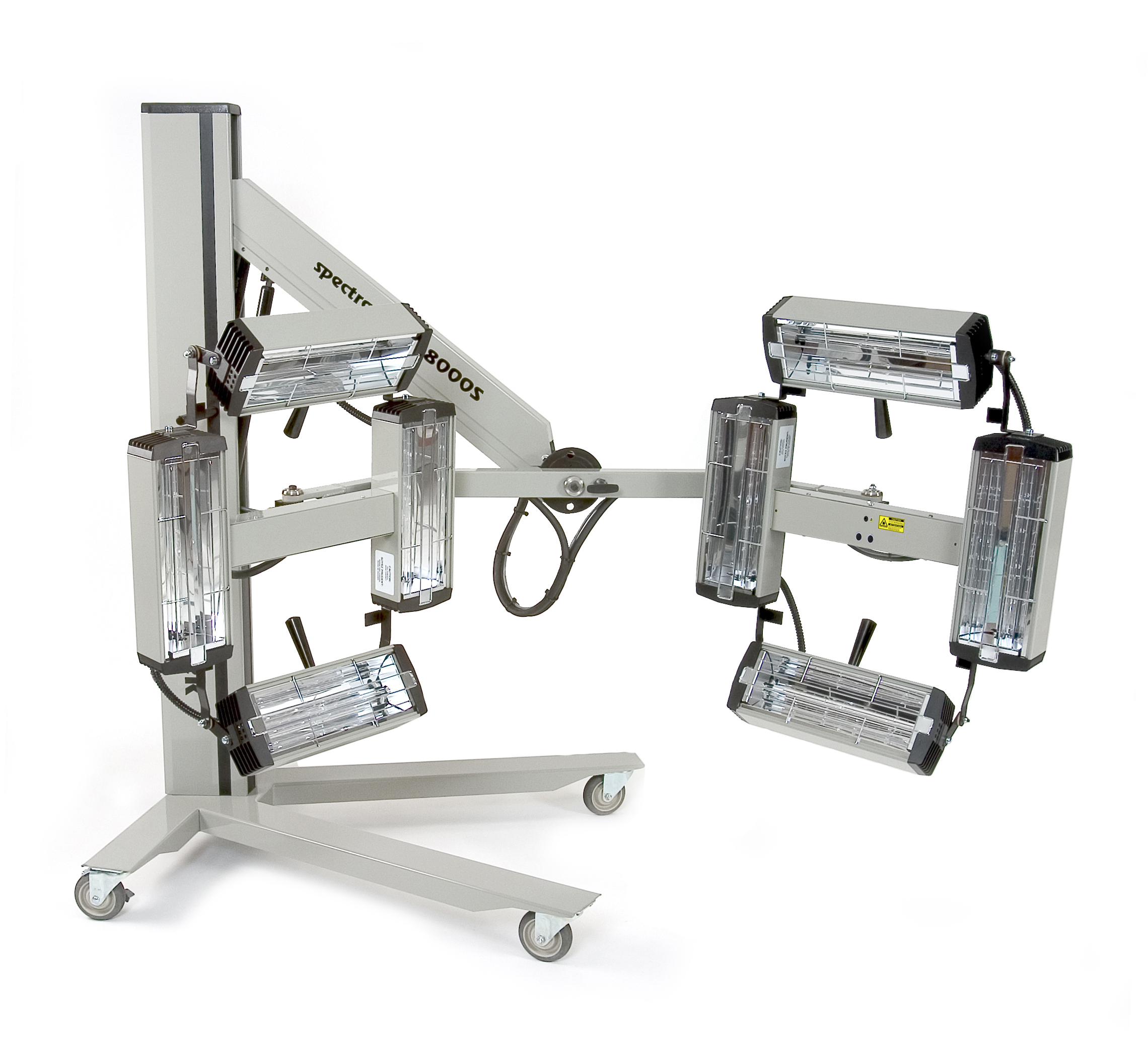
Reduce paint drying bottlenecks with SPECTRATEK SPECTRATHERM short-wave infrared curing systems. Designed to accelerate compatible coating processes, these industrial infrared curing lamps help manufacturers move painted products through production faster, with less waiting and reduced reliance on large drying areas.
Ideal for evaluating finishing applications involving doors, frames, windows, cabinets, garage doors, architectural millwork, and other painted industrial products. For suitable coatings and validated processes, drying or curing stages that normally take hours may be reduced to 30 minutes or less.
Conventional industrial paint drying ovens rely primarily on heated air. Short-wave infrared curing delivers radiant energy directly to the workpiece, where it can heat the coating and underlying substrate. For compatible applications, this targeted heating may accelerate curing, reduce energy spent heating surrounding air, and improve production efficiency.
Selected SPECTRATHERM models feature the Thermal Integrated Sensor System (TISS), which monitors surface temperature and adjusts heating to help maintain controlled curing conditions. Available distance guidance and digital controls further support consistent, repeatable operation.
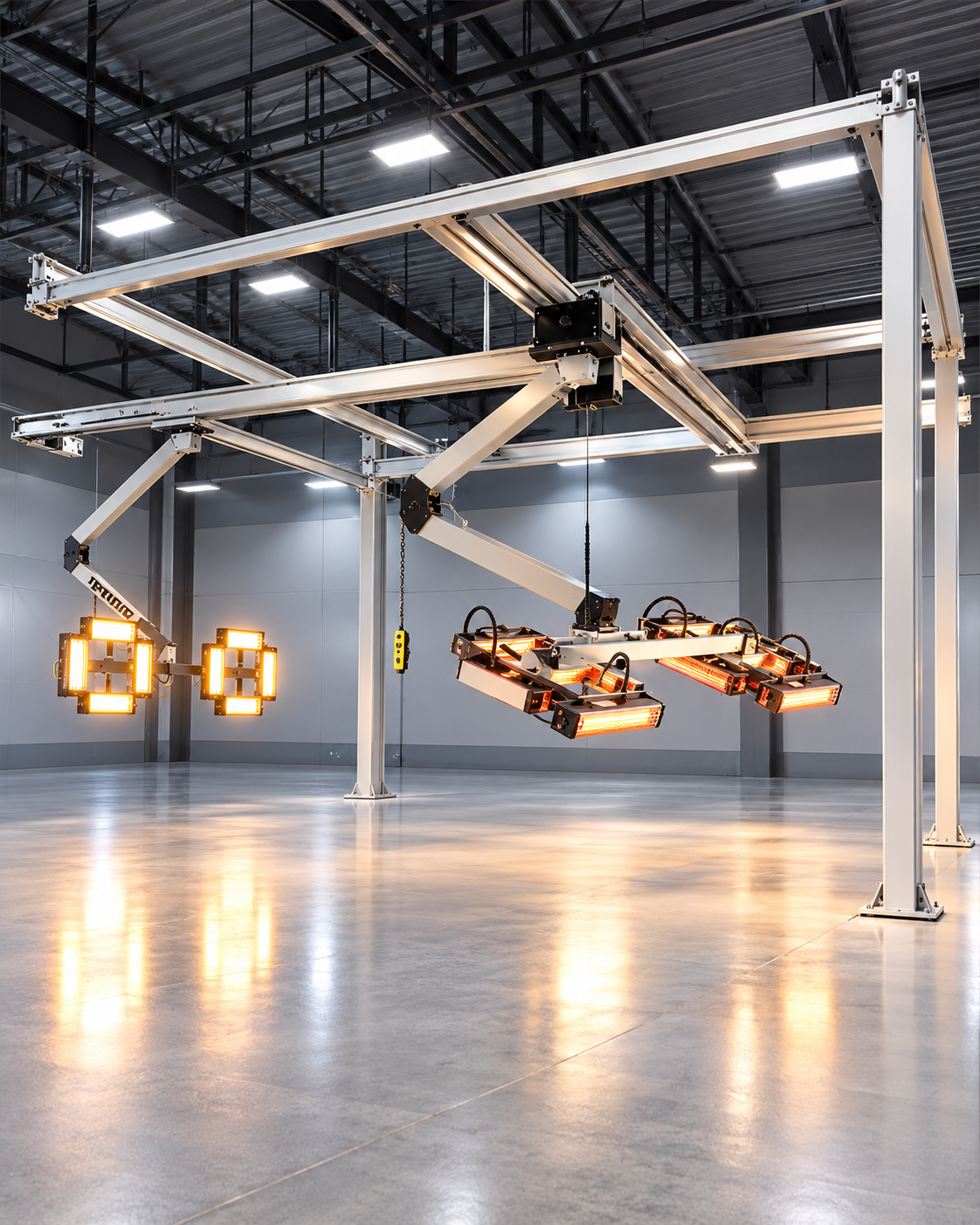
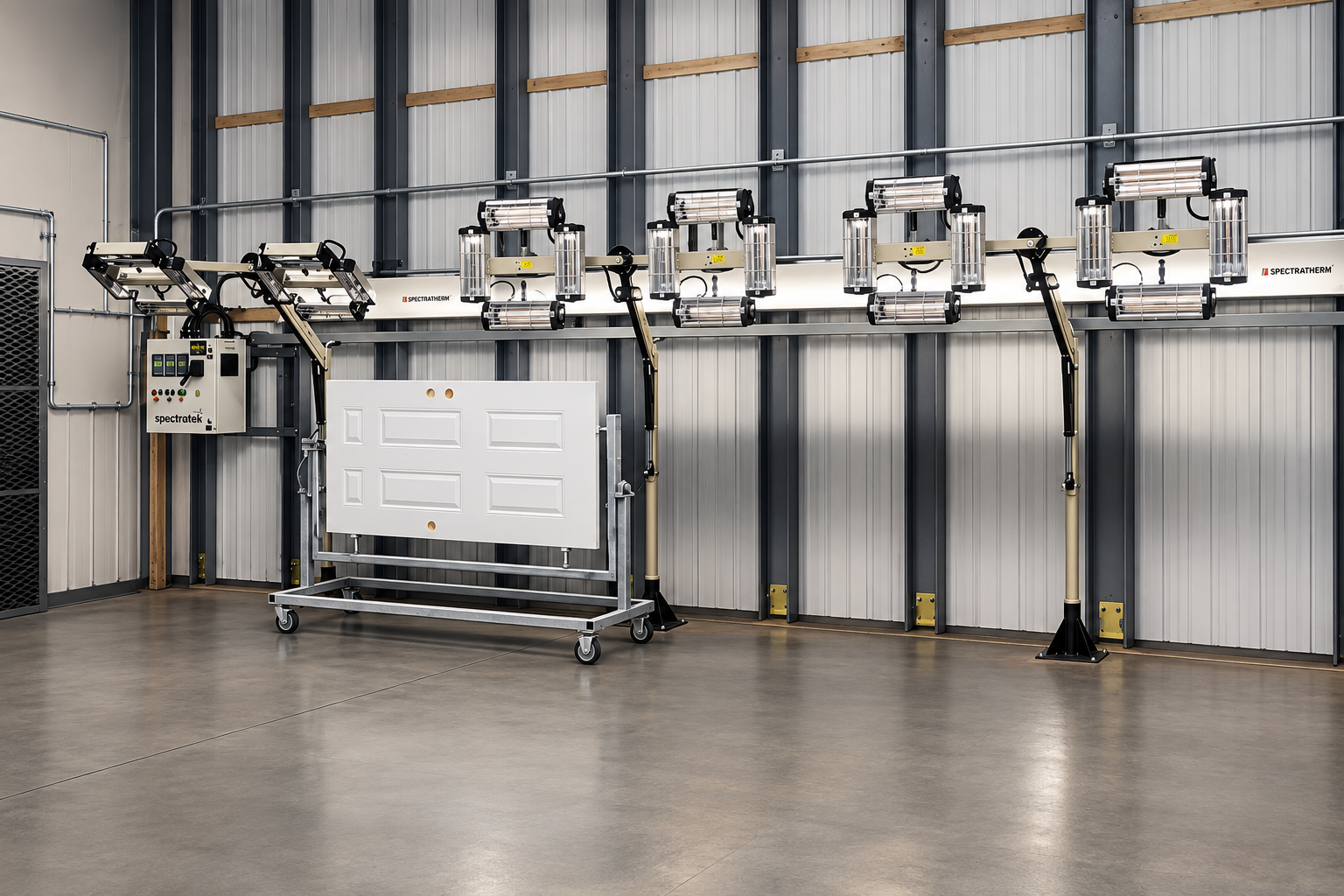
From mobile infrared curing lamps to overhead track installations and custom integration projects, Eugénie International helps manufacturers evaluate equipment that fits their coating process, product dimensions, and production layout.
Not sure whether infrared or UV LED curing is right for your application? Explore our Paint Curing Systems overview or contact our team to discuss your finishing requirements.
Curing performance depends on coating chemistry, substrate, temperature, and process configuration. Results such as 30-minute curing require application-specific validation.
Important: Infrared curing does not guarantee uniform heating throughout every material. Heating depth, temperature distribution, solvent or moisture release, and final coating cure depend on the workpiece and process configuration. Any claim of curing in 30 minutes or less must be validated for the specific industrial application.
| SPECTRATEK Infrared Paint Curing Systems — Frequently Asked Questions | |
| Answers about industrial infrared paint curing, door and millwork finishing, drying ovens, short-wave heating, intelligent temperature control, and faster manufacturing workflows. | |
| How can manufacturers speed up paint drying on doors? | Manufacturers can evaluate short-wave infrared paint curing systems to deliver controlled radiant heat to compatible painted doors. This may reduce drying delays, depending on the coating, substrate, exposure time, and required curing conditions. |
| Can infrared curing reduce paint drying from hours to 30 minutes? | Certain coating and substrate combinations may achieve curing cycles of 30 minutes or less after appropriate process testing. The result depends on the paint chemistry and whether the required endpoint is touch-dry, ready for handling, ready for packaging, or fully cured. |
| What is the difference between an infrared curing system and a conventional paint drying oven? | Convection paint drying ovens use heated air to transfer energy to the workpiece. Infrared curing systems deliver radiant energy that is absorbed by the coating, substrate, or both. Infrared can provide faster targeted heating for suitable applications, while convection remains useful for complex shapes, airflow requirements, and longer controlled curing stages. |
| Can infrared curing replace an industrial paint baking oven? | It may replace or supplement a conventional oven for certain validated applications. The decision depends on coating chemistry, workpiece geometry, required temperature profile, solvent or moisture removal, production volume, and process safety. |
| Does short-wave infrared cure paint beneath the surface? | Short-wave infrared radiation can be absorbed by the coating and underlying substrate, depending on their optical and thermal properties. This creates heat that can transfer through the workpiece. However, full-depth curing is not automatic; the required temperature and chemical curing conditions must be achieved throughout the coating. |
| What is intelligent temperature control in an infrared curing system? | Selected SPECTRATHERM configurations offer the Thermal Integrated Sensor System (TISS). This technology can monitor the workpiece surface temperature and regulate heating to help maintain the selected temperature conditions during curing. |
| Does every SPECTRATHERM lamp have automatic temperature sensing? | No. Sensor functions depend on the specific model and configuration. Basic systems use timer-based controls, while selected advanced models offer digital controls, temperature monitoring, and distance guidance. |
| Can infrared curing work with water-based industrial paints? | Some water-based coatings can benefit from infrared heating, but evaporation and film formation must be managed correctly. The paint manufacturer’s requirements and application testing determine the appropriate curing process. |
| Can infrared curing be used on fiberglass exterior doors? | Infrared heating can be evaluated for painted fiberglass doors when the coating and substrate can tolerate the required temperature profile. Testing must confirm surface appearance, coating adhesion, component integrity, and readiness for subsequent operations. |
| Is infrared curing suitable for wood doors, cabinets, and millwork? | It may be suitable for compatible wood-finishing applications. Coating formulation, moisture content, wood construction, temperature limits, and finish requirements must be reviewed before selecting a curing cycle. |
| Can infrared curing be used for garage doors and window frames? | Suitable painted garage door panels, window components, frames, and other manufactured products can be evaluated for infrared curing. Large surfaces and complex geometries may require multiple lamps or specially engineered heating arrangements. |
| Does infrared curing reduce drying-rack space? | If a validated process allows products to move forward sooner, the time spent in drying racks or staging areas may decrease. Actual space savings depend on production volume, cycle time, workpiece size, and handling requirements. |
| What is the difference between infrared and UV LED paint curing? | Infrared curing uses radiant heat to support compatible thermal drying and curing processes. UV LED curing uses specific ultraviolet wavelengths to initiate curing in specially formulated UV-curable coatings. The two technologies are not interchangeable for every paint system. |
| Can infrared curing systems be integrated into an existing finishing line? | Yes, integration can be evaluated using mobile curing stations, multiple lamp configurations, or overhead track systems. Custom automated installations require engineering review of line speed, heating coverage, material handling, ventilation, and safety. |
| Are automated infrared curing tunnels available? | Custom infrared curing tunnel concepts can be evaluated for appropriate industrial finishing lines. Such systems require application-specific engineering and should not be confused with standard mobile SPECTRATHERM lamp configurations. |
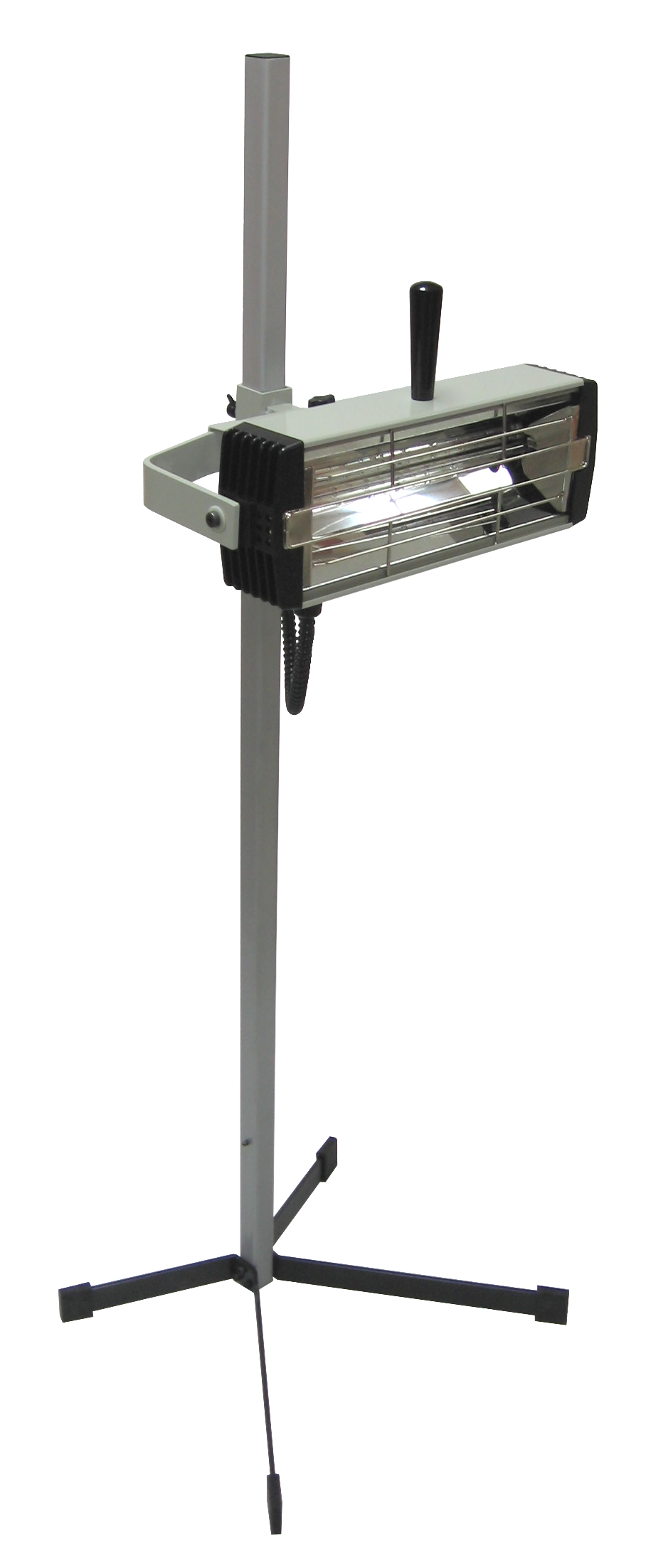
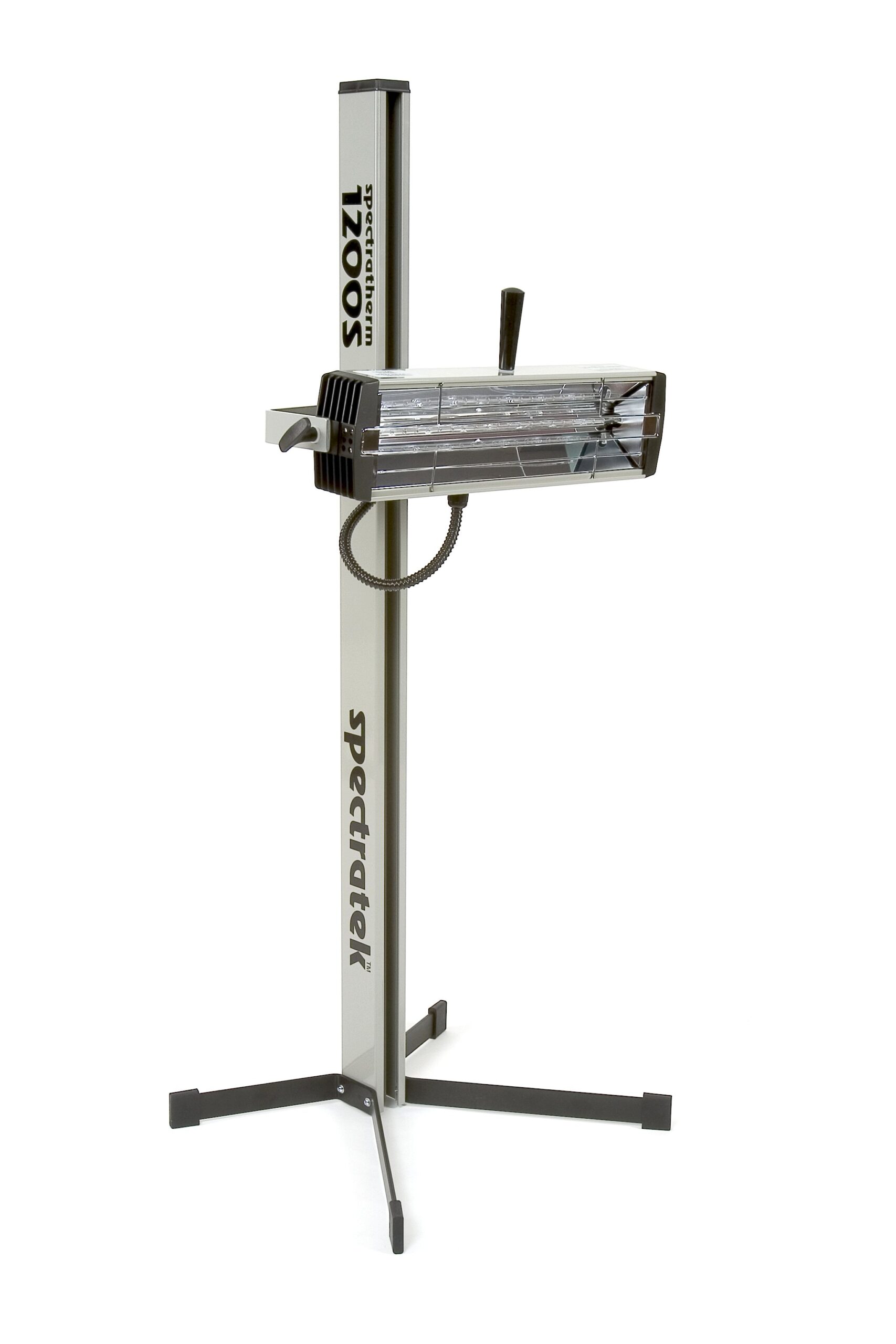
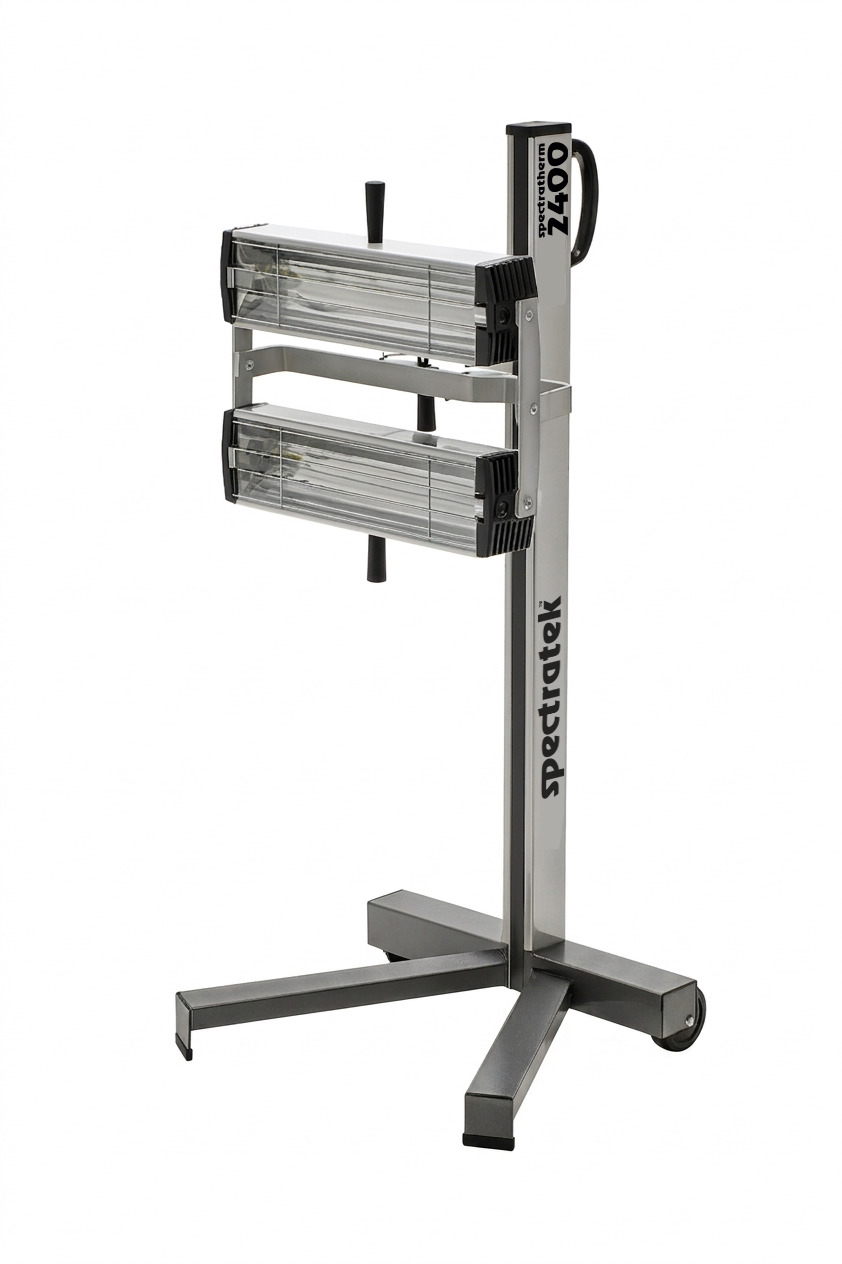
| Which SPECTRATHERM infrared curing models are available? | The range includes compact SPECTRATHERM 1000 and 1200 systems, dual-head 2400 configurations, larger 4000 and 8000 series arrangements, and SPECTRATEK overhead track solutions. Features and electrical requirements vary by exact model. |
| Can infrared curing improve paint quality? | Properly controlled infrared heating may support consistent processing for suitable coatings. However, excessive heating, incorrect exposure, or inappropriate solvent release can damage a finish. Process testing must confirm appearance, adhesion, and final cure quality. |
| Is infrared curing more energy efficient than a conventional oven? | Targeted infrared heating may reduce energy consumption in some processes by limiting unnecessary heating of surrounding air. Actual operating cost and efficiency depend on the equipment, cycle time, workpiece, and comparison oven. |
| What information is needed to evaluate an infrared curing system? | Useful information includes the coating manufacturer and formulation, substrate, current drying time, product dimensions, finishing throughput, required handling time, available electrical supply, and factory layout. |
| How can Eugénie International help reduce paint curing bottlenecks? | Eugénie International can assess a manufacturer’s finishing workflow and help identify suitable SPECTRATEK infrared curing equipment, potential installation configurations, and application-specific testing requirements for faster industrial paint curing. |
For manufacturers of doors, windows, cabinets, garage doors, and architectural millwork, long drying periods can limit production efficiency, increase work-in-progress, and occupy valuable factory space.
SPECTRATEK SPECTRATHERM short-wave infrared curing systems provide an alternative heating technology that can help accelerate compatible industrial paint curing processes. With compact and larger lamp configurations, mobile units, overhead track options, and intelligent temperature monitoring on selected models, manufacturers can explore solutions designed around their finishing requirements.
Discover whether your current drying process could be reduced to 30 minutes or less through appropriate coating tests, system selection, and process validation.
Are painted doors, cabinets, windows, frames, or garage door components sitting in drying racks for hours? Are conventional paint drying ovens creating production delays or taking up valuable factory space?
Contact Eugénie International to evaluate short-wave infrared curing systems for your finishing process. Tell us about your coating type, product dimensions, current drying time, and production requirements so we can help identify suitable equipment and testing options.
Whether you currently use air drying, drying racks, or a conventional industrial paint oven, there may be an opportunity to accelerate your finishing process with SPECTRATEK short-wave infrared curing technology.
Speak with Eugénie International about reducing drying bottlenecks and finding an infrared curing solution suited to your manufacturing operation.


